

2025 Free Cisco 300-215 Exam Files Downloaded Instantly
Pass Cisco 300-215 exam Dumps 100 Pass Guarantee With Latest Demo
Cisco 300-215 exam consists of 60-70 multiple-choice and simulation questions that test the candidates' knowledge and practical skills in conducting forensic analysis and incident response using Cisco technologies. 300-215 exam is divided into five domains: CyberOps Investigations, Forensic Analysis, Incident Response, Remediation, and Reporting.
Earning the Cisco 300-215 certification demonstrates a professional's ability to handle cybersecurity incidents and investigations using Cisco technologies. Conducting Forensic Analysis & Incident Response Using Cisco Technologies for CyberOps certification is highly valued in the cybersecurity industry and opens up various job opportunities. Conducting Forensic Analysis & Incident Response Using Cisco Technologies for CyberOps certification also validates the candidate's ability to work effectively in a team environment and communicate effectively with stakeholders. Overall, the Cisco 300-215 exam is an excellent choice for professionals looking to enhance their knowledge and skills in cybersecurity and advance their careers.
NEW QUESTION # 17
An incident response team is recommending changes after analyzing a recent compromise in which:
* a large number of events and logs were involved;
* team members were not able to identify the anomalous behavior and escalate it in a timely manner;
* several network systems were affected as a result of the latency in detection;
* security engineers were able to mitigate the threat and bring systems back to a stable state; and
* the issue reoccurred shortly after and systems became unstable again because the correct information was not gathered during the initial identification phase.
Which two recommendations should be made for improving the incident response process? (Choose two.)
- A. Implement an automated operation to pull systems events/logs and bring them into an organizational context.
- B. Improve the mitigation phase to ensure causes can be quickly identified, and systems returned to a functioning state.
- C. Formalize reporting requirements and responsibilities to update management and internal stakeholders throughout the incident-handling process effectively.
- D. Allocate additional resources for the containment phase to stabilize systems in a timely manner and reduce an attack's breadth.
- E. Modify the incident handling playbook and checklist to ensure alignment and agreement on roles, responsibilities, and steps before an incident occurs.
Answer: A,E
Explanation:
The Cisco study material recommends integrating automation for log/event collection and contextual analysis to reduce detection delays and ensure rapid identification of anomalies. It also emphasizes the need for pre- defined roles and documented steps in anIncident Handling Playbook, following NIST SP 800-61 Rev.2 standards, to improve consistency and readiness during incidents.
NEW QUESTION # 18
Refer to the exhibit.
Which type of code created the snippet?
- A. VB Script
- B. Bash Script
- C. PowerShell
- D. Python
Answer: A
Explanation:
The syntax in the code snippet includes:
* On Error Resume Next- a classic VBScript error-handling directive.
* function ... end functionstructure.
* Use ofMid(),Chr(), andAsc()functions - all commonly used in VBScript for string manipulation.
* CInt()for conversion - typical in VBScript.
These characteristics alignexactly with VBScript, which is frequently used in malicious macros and obfuscated payloads for malware distribution, as covered in the Cisco CyberOps Associate curriculum when analyzing scripts and encoded threats.
NEW QUESTION # 19
What can the blue team achieve by using Hex Fiend against a piece of malware?
- A. Read the hex data and decrypt payload via access key.
- B. Use the hex data to define patterns in VARA rules.
- C. Read the hex data and transmognify into a readable ELF format
- D. Use the hex data to modify BE header to read the file.
Answer: B
Explanation:
Hex Fiend is a hex editor that allows analysts to examine the raw byte content of files. One key use case is identifying and extracting byte-level patterns or signatures that can be translated into YARA rules for detecting malware. These hex patterns can be used to define precise signature-based detections.
NEW QUESTION # 20
A company had a recent data leak incident. A security engineer investigating the incident discovered that a malicious link was accessed by multiple employees. Further investigation revealed targeted phishing attack attempts on macOS systems, which led to backdoor installations and data compromise. Which two security solutions should a security engineer recommend to mitigate similar attacks in the future? (Choose two.)
- A. secure email gateway
- B. data loss prevention
- C. endpoint detection and response
- D. web application firewall
- E. intrusion prevention system
Answer: A,C
Explanation:
Comprehensive and Detailed Explanation:
* Endpoint Detection and Response (EDR) tools provide behavioral analytics and continuous monitoring to detect malware such as backdoors, which is especially critical on endpoints like macOS devices.
These tools are essential to detect post-compromise activities and contain threats before they spread.
* Secure Email Gateway (e.g., Cisco ESA) plays a key role in blocking phishing emails-the initial vector in this attack. It uses filters and reputation analysis to prevent malicious links or attachments from reaching end users.
Incorrect Options:
* C. DLP focuses on preventing data exfiltration, not phishing prevention or backdoor detection.
* D. IPS is effective for known signature-based threats but less effective against phishing links and endpoint-level backdoors.
* E. WAF protects web servers, not end-user devices from phishing or backdoor infections.
Therefore, the correct answers are: A and B.
NEW QUESTION # 21
Which magic byte indicates that an analyzed file is a pdf file?
- A. 255044462d
- B. cGRmZmlsZQ
- C. 0a0ah4cg
- D. 0
Answer: A
Explanation:
The magic number (also known as a magic byte) is a sequence of bytes used to identify the format of a file.
For PDF files, the standard magic number is:
25 50 44 46, which translates to%PDFin ASCII. OptionC(255044462d) begins with25 50 44 46, confirming it's a PDF file signature. This is a key forensic detail when performing file type identification and validation of potentially obfuscated or renamed files.
NEW QUESTION # 22
Refer to the exhibit.
An engineer received a ticket to analyze a recent breach on a company blog. Every time users visit the blog, they are greeted with a message box. The blog allows users to register, log in, create, and provide comments on various topics. Due to the legacy build of the application, it stores user information in the outdated MySQL database. What is the recommended action that an engineer should take?
- A. Validate input on arrival as strictly as possible.
- B. Implement TLS 1.3 for external communications.
- C. Upgrade the MySQL database.
- D. Match the web server software for the front-end and back-end servers.
Answer: A
Explanation:
The alert box in the screenshot ("HACKED BY 1337") is a classic sign ofCross-Site Scripting (XSS). This occurs when unvalidated input is executed as code in a browser.
To prevent this:
* TheCisco CyberOps Associateguide recommendsstrict input validationas the primary defense against XSS and similar web-based injection attacks.
NEW QUESTION # 23
An organization recovered from a recent ransomware outbreak that resulted in significant business damage. Leadership requested a report that identifies the problems that triggered the incident and the security team's approach to address these problems to prevent a reoccurrence. Which components of the incident should an engineer analyze first for this report?
- A. impact and flow
- B. risk and RPN
- C. motive and factors
- D. cause and effect
Answer: C
NEW QUESTION # 24
Refer to the exhibit.
An employee notices unexpected changes and setting modifications on their workstation and creates an incident ticket. A support specialist checks processes and services but does not identify anything suspicious.
The ticket was escalated to an analyst who reviewed this event log and also discovered that the workstation had multiple large data dumps on network shares. What should be determined from this information?
- A. reconnaissance attack
- B. data obfuscation
- C. brute-force attack
- D. log tampering
Answer: D
Explanation:
The event log shown in the exhibit isEvent ID 104, which in Windows indicates"The audit log was cleared."This is a significant indicator oflog tampering, a common post-exploitation technique used by attackers to hide their tracks after exfiltrating data or performing unauthorized actions.
The Cisco CyberOps Associate guide mentions:
"Log deletion events, especially Event ID 104, should be treated as potential evidence of malicious activity attempting to cover tracks".
Combined with large data dumps to network shares, this indicates not only unauthorized activity but also deliberate efforts to erase forensic evidence-characteristic oflog tampering.
NEW QUESTION # 25
Refer to the exhibit.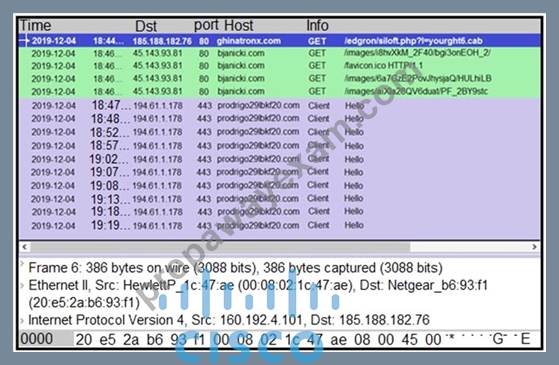
A network engineer is analyzing a Wireshark file to determine the HTTP request that caused the initial Ursnif banking Trojan binary to download. Which filter did the engineer apply to sort the Wireshark traffic logs?
- A. tcp.port eq 25
- B. tcp.window_size ==0
- C. http.request.un matches
- D. tls.handshake.type ==1
Answer: D
Explanation:
Reference:
https://www.malware-traffic-analysis.net/2018/11/08/index.html https://unit42.paloaltonetworks.com/wireshark-tutorial-examining-ursnif-infections/
NEW QUESTION # 26
What is a concern for gathering forensics evidence in public cloud environments?
- A. Timeliness: Gathering forensics evidence from cloud service providers typically requires substantial time.
- B. Configuration: Implementing security zones and proper network segmentation.
- C. High Cost: Cloud service providers typically charge high fees for allowing cloud forensics.
- D. Multitenancy: Evidence gathering must avoid exposure of data from other tenants.
Answer: D
Explanation:
One of the primary concerns when gathering forensic evidence in public cloud environments is the issue of multitenancy. In a shared cloud infrastructure, multiple tenants (organizations or users) operate on the same physical hardware, using virtualization to logically separate resources. This architecture poses a significant challenge for forensic investigations because:
* Forensic investigators must ensure that they do not inadvertently access or expose data belonging to other tenants while collecting evidence.
* This can limit access to low-level system data or hardware-level logs that might be essential for a thorough forensic analysis, since providers must enforce strict data isolation policies.
* This concern is recognized in industry practices and guidelines, including NIST SP 800-86, which underscores the need to collect data in a forensically sound and legally defensible manner-something made more complex in shared environments.
The Cisco CyberOps Associate guide emphasizes the challenges of evidence handling in cloud environments, stating that "gathering evidence in the cloud must be carefully performed to ensure compliance with legal standards and to respect the boundaries of other tenants' data".
Reference:CyberOps Technologies (CBRFIR) 300-215 study guide, Chapter on Digital Forensics and Cloud Environments, Section: Evidence Collection in Shared Infrastructure (Public Cloud).
NEW QUESTION # 27
Refer to the exhibit.
An engineer is analyzing a TCP stream in a Wireshark after a suspicious email with a URL. What should be determined about the SMB traffic from this stream?
- A. It is sharing access to files and printers.
- B. It is redirecting to a malicious phishing website,
- C. It is exploiting redirect vulnerability
- D. It is requesting authentication on the user site.
Answer: C
NEW QUESTION # 28
Refer to the exhibit.
A cybersecurity analyst is presented with the snippet of code used by the threat actor and left behind during the latest incident and is asked to determine its type based on its structure and functionality. What is the type of code being examined?
- A. simple client-side script for downloading other elements
- B. socket programming listener for TCP/IP communication
- C. network monitoring script for capturing incoming traffic
- D. basic web crawler for indexing website content
Answer: B
Explanation:
The Python code snippet:
* Usessocket.socket(AF_INET, SOCK_STREAM), which indicatesTCP communication
* Connects to a remote server (192.168.1.10on port 80)
* Sends a manual HTTPGETrequest
* Receives the response usings.recv()
This is a classic example ofTCP/IP socket programming, specifically creating asimple TCP clientto communicate with a web server. It does not monitor traffic or crawl websites - it sends a crafted request and prints the response.
Thus, this code best fits:
D). socket programming listener for TCP/IP communication.
NEW QUESTION # 29 
Refer to the exhibit. Which type of code created the snippet?
- A. VB Script
- B. Bash Script
- C. PowerShell
- D. Python
Answer: A
Explanation:
Explanation/Reference:
NEW QUESTION # 30
A security team receives reports of multiple files causing suspicious activity on users' workstations. The file attempted to access highly confidential information in a centralized file server. Which two actions should be taken by a security analyst to evaluate the file in a sandbox? (Choose two.)
- A. Inspect file type.
- B. Inspect registry entries
- C. Inspect file hash.
- D. Inspect processes.
- E. Inspect PE header.
Answer: D,E
Explanation:
When analyzing suspicious files in a sandbox environment, a security analyst focuses on identifying and evaluating their behavior in a controlled setting to confirm potential malicious activity:
* Inspect processes (B): Observing the processes that the file spawns or injects into during execution helps identify malicious actions or privilege escalation. This is a crucial part of dynamic analysis in the sandbox environment.
* Inspect PE header (E): The PE (Portable Executable) header contains metadata about how the file will execute on Windows systems. It reveals details such as the entry point, libraries used, and whether the file is suspiciously crafted or packed, which can be strong indicators of malicious behavior.
The other options (A, C, D) are important in the broader forensic analysis, but within thesandbox dynamic analysis, focusing on process behavior and file execution headers is critical for determining how the file interacts with the system and whether it is indeed malicious.
Reference:CyberOps Technologies (CBRFIR) 300-215 study guide, Chapter: Understanding Malware Analysis, Dynamic Analysis of Malware, page 389-392.
NEW QUESTION # 31
Which information is provided about the object file by the "-h" option in the objdump line commandobjdump
-b oasys -m vax -h fu.o?
- A. bfdname
- B. help
- C. debugging
- D. headers
Answer: D
Explanation:
The-hoption in theobjdumpcommand displayssection headersof an object file. According to general usage and command-line documentation, and also explained in digital forensics tools discussions in the CyberOps course, the header information includes details about the name, size, VMA, LMA, file offset, and alignment of each section in the object file. This helps analysts understand how data is stored and organized within compiled files during forensic examinations.
NEW QUESTION # 32
What is an antiforensic technique to cover a digital footprint?
- A. authentication
- B. authorization
- C. obfuscation
- D. privilege escalation
Answer: C
Explanation:
Antiforensic techniques are methods attackers use to cover their tracks. According to the Cisco CyberOps curriculum, "obfuscation" refers to techniques such as encoding, encrypting, or otherwise disguising commands, payloads, or scripts to avoid detection and analysis. This is a standard antiforensic tactic used to prevent attribution and hinder forensic investigation.
Options like privilege escalation and authentication are part of attack vectors or access control and not antiforensic methods.
NEW QUESTION # 33 
- A. Evaluate the file activity in Cisco Umbrella.
- B. Analyze the registry activity section in Cisco Umbrella.
- C. Evaluate the artifacts in Cisco Secure Malware Analytics.
- D. Analyze the activity paths in Cisco Secure Malware Analytics.
Answer: C
Explanation:
The correct next step in analyzing the malicious nature of the email is toevaluate the artifactsinCisco Secure Malware Analytics(formerly Threat Grid). This tool provides a comprehensive sandbox environment where behavioral indicators like file execution, registry access, and domain connections are logged and scored.
The exhibit shows:
* Remote PowerShell execution
* Executable download from a flagged domain
* SHA256 hash linked to malware
All these artifacts, as labeled in the Secure Malware Analytics output, arekey indicators of compromise, and analyzing them further can confirm whether the email was part of a malicious campaign.
Thus, the best action is:
A). Evaluate the artifacts in Cisco Secure Malware Analytics.
NEW QUESTION # 34
Data has been exfiltrated and advertised for sale on the dark web. A web server shows:
* Database unresponsiveness
* PageFile.sys changes
* Disk usage spikes with CPU spikes
* High page faults
Which action should the IR team perform on the server?
- A. Examine the system.cfg file in the Windows directory for improper system configurations
- B. Check the Memory.dmp file in the Windows directory for memory leak indications
- C. Analyze the PageFile.sys file in the System Drive and the Virtual Memory configuration
- D. Review the database.log file in the program files directory for database errors
Answer: C
Explanation:
The combination of CPU spikes, disk usage peaks, and fluctuating PageFile.sys indicates excessive virtual memory paging, which may be a sign of malicious memory or file access behavior. PageFile.sys is part of the virtual memory system, and analyzing it can reveal which processes or payloads are consuming unusual amounts of memory, especially during exfiltration events.
NEW QUESTION # 35
A threat intelligence report identifies an outbreak of a new ransomware strain spreading via phishing emails that contain malicious URLs. A compromised cloud service provider, XYZCloud, is managing the SMTP servers that are sending the phishing emails. A security analyst reviews the potential phishing emails and identifies that the email is coming from XYZCloud. The user has not clicked the embedded malicious URL.
What is the next step that the security analyst should take to identify risk to the organization?
- A. Find any other emails coming from the IP address ranges that are managed by XYZCloud.
- B. Delete email from user mailboxes and update the incident ticket with lessons learned.
- C. Create a detailed incident report and share it with top management.
- D. Reset the reporting user's account and enable multifactor authentication.
Answer: A
Explanation:
Since the phishing email originates from a known compromised cloud provider (XYZCloud), the correct immediate action for the security analyst is to determine the broader scope of exposure. This involves checking whether other users in the organization received similar emails from the same potentially malicious source. Therefore, querying for emails from theIP address rangesorSMTP domainslinked to XYZCloud is essential for identifying other possible attack vectors.
This step aligns with the containment phase of the incident response lifecycle, as outlined in theCyberOps Technologies (CBRFIR) 300-215 study guide, where threat hunting and log analysis are used to determine the extent of compromise and prevent lateral movement or further exposure. Only after the scope is understood should remediation or reporting actions follow.
Reference:CyberOps Technologies (CBRFIR) 300-215 study guide, Chapter: Email-Based Threats and Containment Strategy during Incident Response.
NEW QUESTION # 36 
Refer to the exhibit. An HR department submitted a ticket to the IT helpdesk indicating slow performance on an internal share server. The helpdesk engineer checked the server with a real-time monitoring tool and did not notice anything suspicious. After checking the event logs, the engineer noticed an event that occurred 48 hour prior. Which two indicators of compromise should be determined from this information?
(Choose two.)
- A. denial of service attack
- B. unauthorized system modification
- C. privilege escalation
- D. malware outbreak
- E. compromised root access
Answer: B,E
NEW QUESTION # 37
Refer to the exhibit.
Which type of code is being used?
- A. BASH
- B. Python
- C. Shell
- D. VBScript
Answer: B
NEW QUESTION # 38
Refer to the exhibit.
What is occurring?
- A. An attacker attempted SQL injection.
- B. WAF detected code injection.
- C. The request was redirected.
- D. The requested page was not found.
Answer: D
Explanation:
Comprehensive and Detailed Explanation:
The log entry contains the following key elements:
* The timestamp:(04/Jan/2022:20:18:06 +0000)
* HTTP method and URI:"GET /%60%60%60%60%60%60/ HTTP/2.0"
* HTTP status code:404
* User-Agent:Mozilla/5.0 ... Firefox/95.0
The status code404indicates that the requested resource was not found on the server. This is a standard HTTP response that signifies the server could not locate the requested URI (in this case, likely due to a malformed or invalid path/\`````/, where%60is the URL-encoded form of the backtick character "").
There is no clear evidence of SQL injection, WAF detection, or redirection in this log. The use of encoded backticks may suggest probing behavior, but the log does not show a definitive attack signature.
Therefore, the correct interpretation is:
D: The requested page was not found.
NEW QUESTION # 39
......
More about 300-215 Exam
When you pass this test, Cisco rewards you with the Cisco Certified CyberOps Professional certificate. Apart from this, a candidate who qualifies in the exam will be awarded an individual designation that relates to 300-215 exam only. It is called the Cisco Certified CyberOps Specialist - CyberOps Forensic Analysis & Incident Response. Note, however, that for the Cisco Certified CyberOps Professional certification, one must begin with the core technology-related test referred to as 350-201 CBRCOR.
Read Online 300-215 Test Practice Test Questions Exam Dumps: https://exam-hub.prepawayexam.com/Cisco/braindumps.300-215.ete.file.html